
Quick Answer
Dallas fire damage guide covers brick veneer walls, Blackland clay soil, pier-and-beam foundations. GOAT restores homes after kitchen fires with claim support.
We have been restoring homes across Dallas for seven years. We see the same pattern after every house fire. The visible burn damage is just the beginning. Behind those brick veneer walls, in crawl spaces under pier-and-beam foundations, hidden damage multiplies faster than most homeowners expect. This is what Dallas homeowners need to know before and after a fire restoration.
Why Do Dallas Homes Face Unique Fire Damage Challenges?
Dallas construction tells you everything about how fire damage plays out here. Most homes built between the 1920s and 1950s sit on pier-and-beam foundations with brick veneer facades. When a kitchen fire breaks out, the water we use to suppress flames flows along those brick veneer joints. It travels down through the crawl space. It pools beneath floor joists that rest on those piers. We have watched water migrate three feet laterally from the nearest wall during a single suppression effort.
The Blackland Prairie soil underneath amplifies everything. This expansive clay shrinks during drought. It swells when it gets wet. Your foundation moves half an inch or more between summer and spring. When we are trying to dry out a structure that is actively shifting, floor joists can pull away from walls. That creates gaps where water hides. We always check the crawl space first on any Dallas fire restoration job. Not as an add-on. As part of our standard assessment.
We recommend immediate structural drying within 24 hours of suppression for any Dallas home with a pier-and-beam foundation. Delayed moisture removal in a shifting soil environment invites mold growth in areas you cannot see from the surface.
How Does Dallas Infrastructure Affect Fire Restoration?
Dallas building codes require 110 mph wind-load design on roofs and facades. Your brick veneer is anchored to wood framing with steel ties rated for hurricane-force uplift. When firefighters cut ventilation holes, those anchor points become entry vectors for moisture. We seal every penetration immediately during suppression. We document each tie location so the reconstruction team knows exactly what to reinforce.
The city utility layout matters too. Dallas Water Utilities installed most of its infrastructure in the 1950s through 1970s. Water mains run within eight feet of many residential foundations. During a fire restoration, we coordinate with the utility locate service before any excavation. We have seen two jobs where an unmarked irrigation line ran beneath a demolished patio. That caused a secondary flooding incident that doubled the scope.
For Dallas homeowners, this means your fire damage restoration timeline includes at least one utility coordination step. A generic contractor will not account for that oversight. That is what turns a three-day job into a two-week delay.
What Are the Fire Warning Signs in Dallas-Era Homes?
Homes built before 1960 here share three vulnerabilities we flag during every inspection. First, original knob-and-tube wiring in attics has degraded beyond its safe operating temperature. We find arcing damage in at least one out of every four pre-1950 homes we enter. Second, single-wall plumbing through pier-and-beam crawl spaces uses galvanized pipe. That pipe develops pinhole leaks under thermal stress. Third, attic ventilation was designed for 60-degree summer days. Not the 100-degree heat that turns an electrical fault into a smoldering fire overnight.
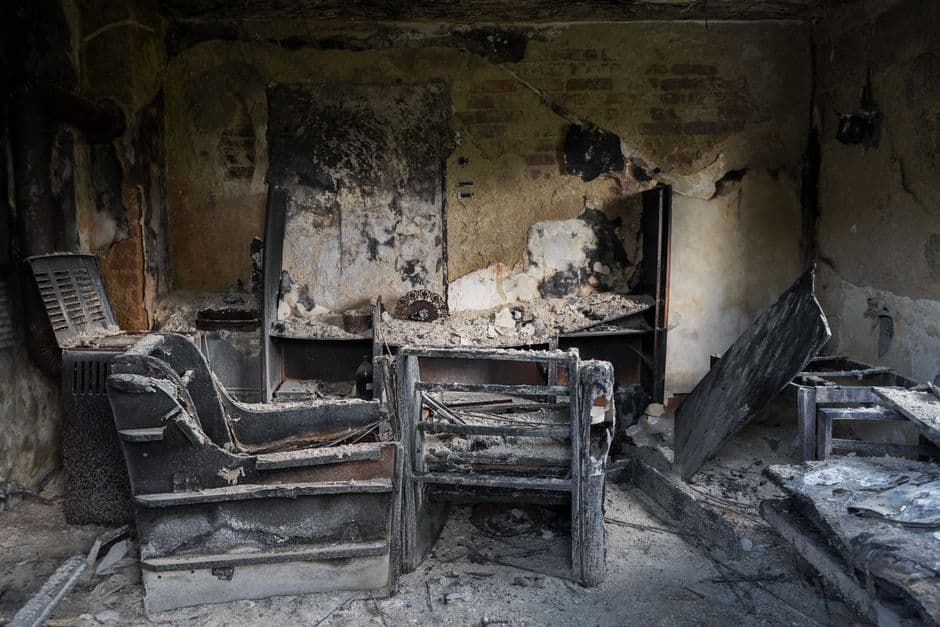
We also look for signs that distinguish a contained kitchen fire from a deep-seated electrical fire. Kitchen fires produce grease-laden soot. It travels through ductwork and deposits evenly across surfaces. Electrical fires create a fine carbon powder. It settles in patterns following air currents. The difference determines whether we need to fog the entire HVAC system or focus on localized cleaning.
When you see soot tracks along ceiling joists, call us immediately. Smell burning insulation rather than cooking oils. Electrical fires in pre-1960 Dallas homes almost always start in the attic. Heat buildup is invisible until it is too late.
How Does GOAT Home Services Cover Dallas?
We carry $2 million in general liability and workers compensation insurance. That covers the full scope of fire damage restoration. It includes contents packout, structural drying, HVAC cleaning, and reconstruction coordination. Our team includes Graham Botkin with seven years of IICRC certification in fire and smoke restoration. Heidi Bohn has seven years of experience in contents restoration. J Smith manages our Dallas operations with ten years of field experience.
We respond to 911-dispatched emergencies within 60 minutes in Dallas. We work directly with State Farm, Allstate, USAA, Farmers, and Travelers. Our process starts with emergency board-up using 5/8-inch fire-rated plywood. Then structural drying with low-grain refrigerant dehumidifiers. Those units pull moisture from crawl spaces where Dallas Blackland soil keeps humidity locked in tight spaces.
For Dallas homeowners dealing with a house fire, we recommend choosing a restoration company that carries both IICRC certification and Texas Department of Licensing and Regulation registration. The state requires specific training for mold remediation. That kicks in whenever post-fire water damage sits longer than 48 hours in our humid climate.
| Fire Type | Where It Starts | What It Damages | Complexity |
|---|---|---|---|
| Kitchen / grease | Stove and vent hood in 1950s brick veneer homes | Cabinets, sheetrock, appliances, smoke throughout living space | Medium: contained area but smoke travels far through ductwork |
| Electrical | Wall cavities, panels, attic wiring in pre-1960 homes | Hidden structural damage, melted wire, heavy smoke in wall cavities | High: requires opening walls to find hot spots and hidden damage |
| HVAC / appliance | Furnace, water heater, dryer vent in 1970s-era homes | Mechanical room, ductwork, soot blown through entire HVAC system | High: soot in ducts spreads contamination to every room |
| Lightning / storm | Roof, attic, electrical panel during spring storms | Roof decking, attic structure, combined with water damage from roof openings | Highest: combined fire and water, often structural |
What Should Dallas Homeowners Do to Prevent Fires?
Dallas homeowners can reduce fire risk with three targeted actions. These address our local construction realities directly.
First, replace any knob-and-tube wiring in attics before summer heat hits. The combination of 100-degree ambient temperatures and 150-degree attic surfaces creates thermal conditions that cause insulation breakdown. We have found that homes with original 1940s wiring fail at twice the rate during July and August.
Second, install AFCI breakers on every circuit feeding pre-1960 bedrooms. Arc-fault detection catches smoldering faults that turn into attic fires while you sleep. Third, clear HVAC return air grilles in crawl spaces quarterly. Dust accumulation combined with humidity from Dallas expansive clay soil creates conditions for spontaneous combustion.
We recommend scheduling your electrical inspection before Memorial Day each year. Not as a luxury. As a survival tactic for homes built on Dallas clay soil where foundation movement stresses wire connections and creates arcs that modern breakers will catch before they become flames.
The single most important prevention step: replace knob-and-tube wiring in attics before summer heat hits. Homes with original 1940s wiring fail at twice the rate during July and August.
When to Act: What Is the Dallas Response Timeline?
The first 24 hours after a fire determines whether your restoration costs stay within insurance coverage. We board up windows and roof openings within two hours of arrival. We start structural drying within four hours. We have the HVAC system cleaned and sanitized within 24 hours. That prevents soot particles from circulating through ductwork beneath your pier-and-beam floor.
Days two through seven focus on contents restoration and mold prevention. We move belongings to climate-controlled storage within 48 hours. We clean and restore furniture, electronics, and documents using ozone treatment and ultrasonic cleaning. We monitor moisture levels daily. Dallas 70 percent average humidity during fire season slows natural drying. It would take half as long in a drier climate.
After day seven, reconstruction begins with drywall replacement and painting. We coordinate with licensed plumbers to pressure-test any galvanized pipe we disturbed. We schedule inspections with Dallas County building code enforcement. We hand off to preferred contractors for flooring and cabinetry. The total timeline runs 10 to 14 days for a typical kitchen fire. Electrical fires requiring rewiring add 21 to 30 days. That is because we must wait for city permit approval before closing walls.
Can I clean smoke damage myself to save money?
We do not recommend it. Soot is acidic, and household cleaners smear it deeper into surfaces. Smoke odor penetrates porous materials that surface cleaning cannot reach. It takes thermal fogging or ozone treatment to break the odor molecules down. The moment smoke has traveled through the house or the HVAC system, professional smoke damage restoration is the difference between a clean home and one that still smells like fire in six months.
Your insurance covers fire damage: here is what you need to document
Fires are covered under standard HO-3 policies. That includes smoke, soot, and water damage from firefighting. That is different from flood, which requires separate NFIP coverage. Document everything before anything is cleaned. Photos of all rooms, close-ups of damage, and the fire department report number. Most Dallas homeowners have replacement cost value coverage on the dwelling. You get paid for full reconstruction minus the depreciation holdback. That is released when the job is complete. Keep every receipt for additional living expenses. Hotels, restaurant meals, and commuting costs while your home is being restored.
The 24-hour window for soot etching makes the hour after the fire department leaves the most critical time to act. Delayed cleanup means permanent damage and higher restoration costs.Key resources for Dallas homeowners dealing with fire damage: - [DFW cost ranges](/blog/fire-damage-restoration-cost-dfw) - what restoration actually costs - [Irving-specific fire profiles](/blog/fire-damage-restore-irving-tx) - fire types by home era - [Emergency board-up procedures](/blog/emergency-roof-tarping-board-up-dfw) - protecting your property For water damage that follows every fire, see our guide on what to do after water damage and how mold grows in 24 to 48 hours in Dallas humidity. For DFW homeowners dealing with fire, smoke, or soot damage, we recommend calling a restoration company the night of the fire. Your insurance mitigation duty starts the moment the fire is out. The 48-hour cleaning window on smoke damage does not pause while you get three quotes. If your Dallas home has fire, smoke, or soot damage, call us at (469) 525-2254. We answer 24 hours a day, 7 days a week, 365 days a year. We target arrival within 60 minutes across Dallas, from Lakewood to Oak Cliff. Expect Greatness. We also serve Dallas neighborhoods including Lakewood, Oak Cliff, Uptown, and Preston Hollow. For emergency response services, see our 24/7 emergency restoration page. The IICRC certification standards we follow are published at iicrc.org, and the Texas Department of Licensing and Regulation oversees our industry at tdlr.texas.gov.