
Quick Answer
Hail damage in DFW can turn a $300 emergency tarp into a $30,000 restoration job. What to do after a hailstorm hits your Plano or Frisco home, how insurance covers it, and the full restoration process.
Hail season in North Texas hits without much warning. A sunny afternoon turns black in minutes, the wind picks up, and then the pounding starts. We have responded to homes across Plano, Frisco, McKinney, and the entire DFW metro after hailstorms that lasted seven minutes and caused $50,000 in damage. Hail damage is deceptive, too: what looks like a few dings on the roof from the ground can be a complete replacement once a roofer or restoration company gets up there and inspects.
This guide covers what DFW homeowners need to know about hail damage: how to spot it, what to do immediately after a storm, how insurance handles it, what restoration and tarping costs, and the timeline for getting your home back in shape.

How Much Damage Can Hail Actually Do?
The answer depends on hailstone size, wind speed, and your roofing material. Here is what we see on DFW homes after the major storms that move through Collin County, Denton County, and Dallas County each spring and summer:
| Hail Size | Diameter | Damage to Composition Shingles | Damage to Tile/Metal | Typical Claims Outcome |
|---|---|---|---|---|
| Pea | 0.25 in | Minimal cosmetic | None | No claim |
| Quarter | 1.0 in | Granule loss, minor bruising | None on metal; some tile may crack | Partial roof replacement possible |
| Golf Ball | 1.75 in | Fractured shingles, exposed mat | Cracked or broken tile | Full roof replacement likely |
| Baseball | 2.75 in | Penetrated shingles, splits | Broken tile, dented metal | Full replacement + interior damage |
| Grapefruit+ | 4.0+ in | Complete shingle failure | Extensive breakage | Full roof + structure + interior |
DFW averages 2 to 3 significant hail events per year, concentrated in March through June and again in September through October. The largest hailstone ever recorded in Texas was a grapefruit-sized 6.4 inches that fell in Central Texas in 2014. North Texas sees golf-ball-sized hail roughly every 2 to 3 years.
What to Do Immediately After a Hailstorm
The first hour after a hailstorm ends is the most important. Here is the sequence we recommend to every DFW homeowner who calls us after a storm passes:
-
Wait until it is safe to go outside. Hailstorms often come with lightning, high winds, and the possibility of live power lines down. Do not go outside until the storm has fully passed and you have confirmed there are no downed wires near your home.
-
Look for visible damage from the ground. Walk around the perimeter of your house and look for dented gutters, broken siding, cracked windows, or missing shingles. Use binoculars to inspect the roof from the ground. Do not climb onto the roof yourself, especially if it is wet or if the shingles are compromised.
-
If the roof was compromised, water may already be entering the attic or upper floors. Look for water stains on the ceiling, wet insulation in the attic, and drips from light fixtures or ceiling fans. For more on what ceiling stains mean, read our guide on what a water stain on your ceiling means.
-
Contain any active leaks. If you have a leak, place a bucket or tarp under the drip point and move valuables out of the path of the water. If the leak is large or the ceiling is sagging with water weight, call a 24-hour emergency response company immediately. A sagging ceiling can collapse without warning.
-
Secure the exterior. If there are broken windows, cover them with plywood or heavy-duty contractor bags and duct tape. If the roof has visible holes or missing shingles and more rain is forecast, emergency tarping or board-up is the priority. Water intrusion from an unsecured roof after a hailstorm is the fastest way to turn a $10,000 roof replacement into a $40,000 restoration job.
Warning
Do not wait to address roof damage after a hailstorm. DFW weather patterns mean a second storm system can arrive within 48 hours. An unsecured roof that took minor hail damage can become a catastrophic water loss if a second storm moves through. Emergency tarping costs $300 to $800 and can prevent $10,000 to $30,000 in interior water damage. It is the single most cost-effective step you can take after a hailstorm.
Insurance Claims for Hail Damage in Texas
Hail damage is covered under standard HO-3 homeowners insurance policies in Texas. It falls under the wind and hail peril, which is included in most DFW-area policies. Here is what you need to know about the claims process specific to hail damage:
How the Hail Damage Claims Process Works
The process starts with a phone call to your insurance company. Report the damage and request an adjuster inspection. In DFW after a major hailstorm, adjusters can take 7 to 14 days to get to your property because hundreds of homes in the area filed claims the same day. The adjuster will inspect the roof, gutters, siding, windows, and any interior damage. They will write an estimate based on the visible damage. If the restoration company's estimate is higher than the adjuster's (which it almost always is), the restoration company submits a supplemental claim with photographic evidence. Most supplements are approved within 1 to 2 weeks. The insurance company pays the restoration company directly after the work is completed. You pay your deductible, which for wind and hail claims is typically 1 percent of your dwelling limit.
DFW-Specific Insurance Considerations
Some DFW-area policies have a separate wind and hail deductible that is higher than the standard deductible. In Texas, these deductibles can be 1 percent, 2 percent, or even 5 percent of the dwelling limit. On a $400,000 home, a 2 percent wind and hail deductible is $8,000. Check your policy declaration page before filing a claim if you are unsure. Also: some roofs older than 15 to 20 years may receive a reduced payout based on depreciation, even if the policy includes replacement cost coverage. The insurance company may pay actual cash value (replacement cost minus depreciation) for an older roof rather than full replacement cost.
What If the Adjuster Says the Damage Is Not Enough for a Claim?
This happens frequently in DFW after borderline hailstorms. An adjuster may determine that the hail was too small or the damage too minor to warrant a full roof replacement. In that case, you have options: request a reinspection from a different adjuster, hire a public adjuster who works for you rather than the insurance company, or work with a licensed roofing contractor who has experience getting supplement claims approved for hail damage. Jumping on the roof yourself with chalk to circle every impacted shingle is not the answer. Your best option is a restoration company or a roofer who has navigated DFW hail claims before.
Emergency Roof Tarping and Board-Up Services
After a hailstorm that has compromised the roof, emergency tarping is the critical step that separates a manageable claim from a catastrophic one. Here is what it involves:
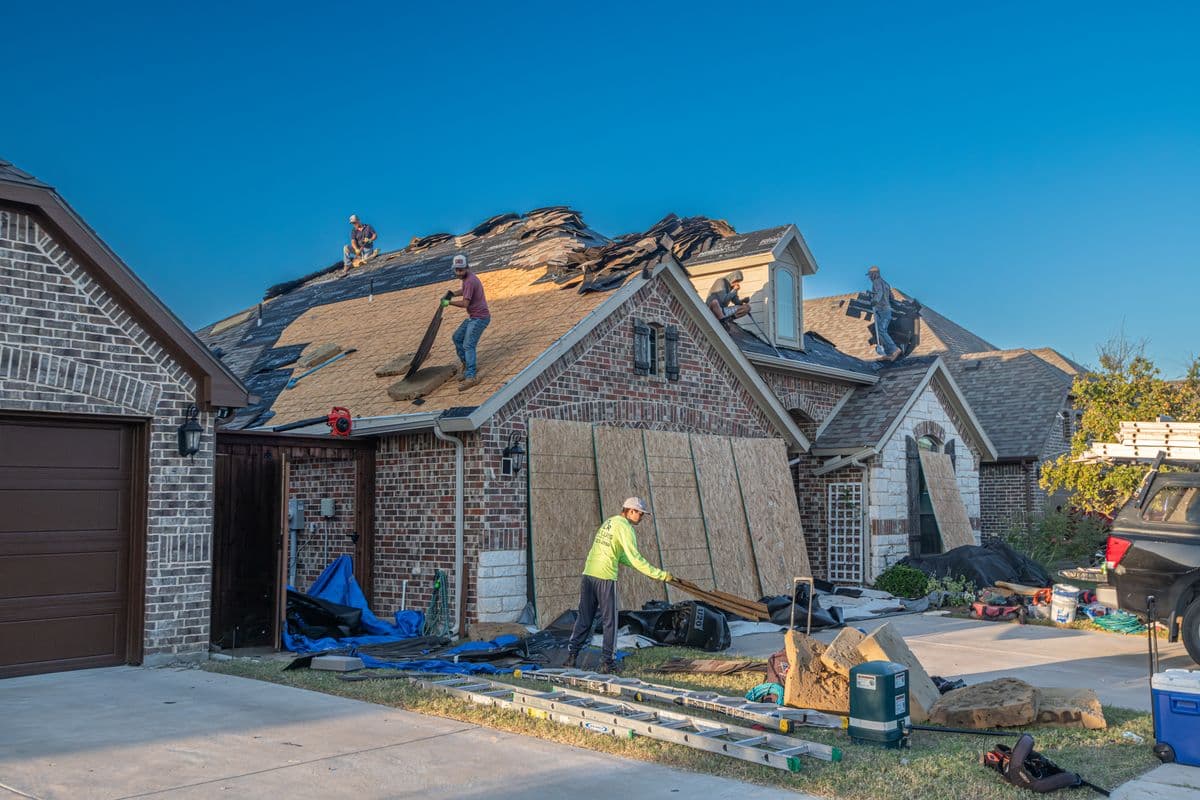
A restoration crew arrives with heavy-duty blue or reinforced polyethylene tarps, cap nails, and wood battens. They inspect the roof from above, identify every breach point, and secure tarps over the damaged areas. The tarps are nailed along the edges and across the surface to prevent wind from lifting them. A properly installed tarp can withstand moderate wind and rain for 30 to 60 days, which gives you time to work through the insurance claim and schedule the permanent roof replacement.
Board-up services cover broken windows and doors with 5/8-inch plywood secured with screws or nails into the surrounding framing. Board-up prevents further weather intrusion and secures the home against trespassing after a storm. Most insurance policies cover emergency tarping and board-up as part of the loss mitigation coverage.
Our Recommendation
If you have roof damage after a hailstorm and more rain is in the forecast, call for tarping immediately. Do not wait for the insurance adjuster to inspect first. The adjuster can inspect through the tarp or remove it temporarily. The cost of tarping, typically $300 to $800, is covered by insurance as part of the mitigation claim. The cost of interior water damage from waiting, typically $5,000 to $30,000, is not always fully covered. Getting the tarp on first protects your claim and your home.
Hail Damage Restoration: The Full Process
When the hailstorm passes and the emergency tarping is done, the restoration process follows a standard sequence. Here is the timeline from the moment the tarp goes on to the final walkthrough:
-
Emergency stabilization (Day 1). Tarping, board-up, and water extraction if interior damage has already occurred. The goal is to stop further damage and prevent mold growth, which can begin within 24 to 48 hours of water intrusion in DFW's humid climate.
-
Insurance adjuster inspection (Days 3 to 14). The adjuster inspects the property and writes an initial estimate. The restoration company project manager should be present at this inspection to ensure the scope of work is accurately captured.
-
Demolition and drying (Days 5 to 14). If water entered the home, affected drywall, insulation, and flooring are removed. Structural drying with air movers and dehumidifiers begins. Moisture levels are monitored daily until everything is below the dry standard.
-
Roof replacement or repair (Week 2 to 4). Once the insurance claim is approved, a roofing contractor replaces the damaged roof. If the restoration company handles the full project, they coordinate with the roofer.
-
Interior reconstruction (Week 3 to 8). Replacing drywall, insulation, flooring, trim, and paint. If the damage was extensive, this stage can take longer depending on material availability and contractor schedules in the active DFW construction market.
-
Final walkthrough and claim closeout (Week 4 to 10). The restoration company walks through every repaired area with the homeowner, confirms the work matches the insurance scope, and submits the final invoice to the insurer for payment.
What Hail Damage Restoration Costs in DFW
The cost of hail damage restoration varies widely based on the size of the roof, the damage severity, whether water entered the home, and the materials involved. Here are the typical cost ranges for DFW homes:
| Scope | Typical Cost Range | What It Covers |
|---|---|---|
| Emergency tarping (single section) | $300 - $800 | Heavy tarp, installation, inspection |
| Board-up (per window/door) | $150 - $400 | Plywood, screws, labor |
| Interior water mitigation | $1,500 - $7,000 | Water extraction, drying, demo, antimicrobial |
| Roof replacement (3,000 sq ft) | $8,000 - $18,000 | Materials, labor, disposal, underlayment |
| Full restoration with interior rebuild | $15,000 - $50,000+ | Roof + interior drywall, insulation, flooring, paint |
These ranges are based on typical DFW pricing as of 2026. Your actual costs will depend on your specific home, your insurance deductible, and the extent of the damage. Most of this cost is covered by insurance after the deductible.
Hail Damage vs. Other Storm Damage: What DFW Homeowners Should Know
Hail damage is different from other types of storm damage in ways that matter for insurance claims and restoration strategy. For a broader overview of how to prepare for severe weather, see our North Texas storm season preparation guide. Here is how hail compares with wind damage and flood damage:
| Factor | Hail Damage | Wind Damage | Flood Damage |
|---|---|---|---|
| Primary cause | Ice impact | Uplift, tearing | Water intrusion from ground |
| Insurance coverage | HO-3 wind/hail peril | HO-3 wind peril | Separate flood policy required |
| Deductible type | Wind/hail % deductible | Wind % deductible | Flat flood deductible |
| Typical damage pattern | Roof, gutters, siding, windows | Roof, fences, trees, siding | Foundation, slab, lower level |
| Emergency response | Tarp + board-up | Tarp + board-up | Water extraction + drying |
The critical difference for DFW homeowners: hail and wind damage are typically covered under the same HO-3 peril, but flood damage requires a separate NFIP or private flood policy. A hailstorm that damages the roof and lets rain into the house is a wind/hail claim. The same rain entering through a ground-level door during flash flooding is a flood claim. The distinction matters because the deductible and coverage limits are different.
Frequently Asked Questions About Hail Damage in DFW
How long do I have to file a hail damage insurance claim in Texas?
Texas insurance policies typically require that you notify your carrier within 1 to 2 years of the storm date. However, we strongly recommend filing within 30 days. The longer you wait, the harder it is to prove the damage was caused by a specific storm. Insurance adjusters are more skeptical of claims filed months after the event. If you had a hailstorm on your property this week, file the claim this week.
Can hail damage cause mold?
Yes. Hail damage does not directly cause mold, but a compromised roof that allows water intrusion creates the conditions for mold growth. DFW humidity is above 60 percent from May through September, which means wet drywall and insulation inside an attic or upper floor will begin showing mold colonization within 24 to 48 hours. If you had a hailstorm and noticed a musty smell or visible discoloration in the following days, water has already entered the home and mold may be growing.
Should I get multiple quotes for hail damage restoration?
You should get at least two inspections: one from a licensed roofing contractor and one from a licensed restoration company that handles the full scope of work including interior water damage. A roofer will only address the roof. A restoration company will handle the roof, the interior mitigation, the drying, the reconstruction, and the insurance paperwork. For storm damage that has already allowed water into the home, a restoration company is the right single point of contact.
Does homeowners insurance cover emergency tarping?
Yes. Emergency tarping and board-up are classified as reasonable mitigation measures under most homeowners policies. Insurance companies expect homeowners to prevent further damage after a loss. Tarping a damaged roof is the standard mitigation step. The cost is included in the total claim payout. Keep the receipt and the work order from the restoration company for your adjuster.
What happens if I miss the insurance claim deadline?
If you miss the deadline in your policy, the insurance company can deny the claim entirely. Texas has a statute of limitations of two years for breach of contract claims against insurance companies, but most policies include a shorter contractual deadline, often 1 year from the date of loss. If you are reading this and realized you had hail damage from a storm 11 months ago, file the claim immediately and explain the delay. A late claim has a chance at approval. A claim filed after the deadline has no chance.
Key Takeaways for DFW Homeowners
Hail damage in North Texas follows a predictable pattern: a storm moves through, the roof takes damage you cannot see from the ground, and water enters the home during the next rain event. The timeline from hailstorm to interior water damage can be as short as 24 hours. Emergency tarping is the most cost-effective step you can take. Insurance covers hail damage under the wind and hail peril of standard HO-3 policies, but the deductible may be a percentage of your dwelling limit. Check your policy before filing. If you have roof damage or suspect your home was hit by hail, call a licensed restoration company that handles the full scope of work from tarping through reconstruction.
If you are in Dallas, Plano, Frisco, McKinney, Carrollton, Garland, Arlington, Irving, or any DFW city and need emergency tarping, board-up, or a full hail damage assessment, call (469) 525-2254. We respond 24 hours a day, 7 days a week, 365 days a year. If the tarps can wait until tomorrow because the forecast is clear, we schedule at your convenience. If the roof is leaking right now, we are there in under 60 minutes.